 by
by By a tech blogger who actually did it · May 2026 · 11 min read
Honestly? I almost didn’t do it. Seven days of back-to-back Shorts felt like a punishment, not a strategy. I had a small YouTube channel that was basically on life support — maybe 80 to 100 views per long-form video, a subscriber count that hadn’t moved in two months, and this creeping feeling that I was uploading into a void.
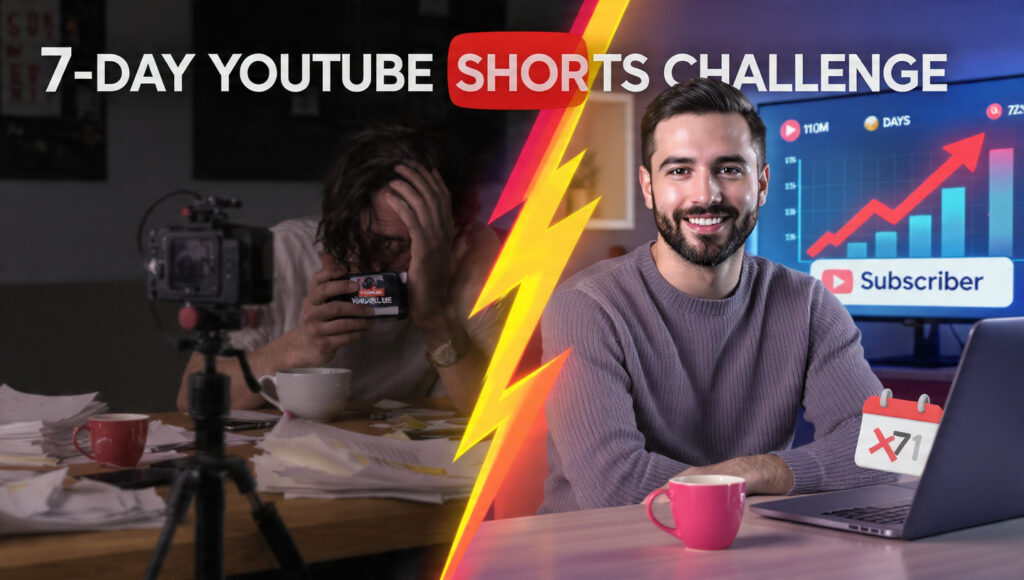
Then a friend dared me. “Just try it for a week,” he said. “Worst case, nothing happens and you delete them.” That’s the kind of logic that’s very easy to agree with on a Sunday evening when you haven’t actually thought about what filming seven vertical videos in seven days really looks like at 11 PM on a Wednesday.
But I did it. And I want to tell you exactly what happened — the good stuff, the embarrassing stuff, and the things I genuinely wish someone had told me before I started.
Why I Decided to Take Shorts Seriously
For a long time, I treated YouTube Shorts like a side dish nobody ordered. My “real” content was the long-form stuff — 10 to 15 minute tutorials about tech topics. I’d spent hours editing those videos, obsessing over B-roll and colour grading, and they’d get maybe 120 views in the first week. Decent, but nothing that moved the needle.
What finally convinced me to try Shorts was looking at my own analytics. There was one Short I’d uploaded almost accidentally — a 40-second clip I’d trimmed from a longer video — and it had quietly pulled in 3,400 views without me doing a single thing. Meanwhile, the full video it came from? 200 views. The math felt rude.
The algorithm clearly wanted to push short content. I was just refusing to meet it halfway.
So I set a rule for myself: one Short every day for seven days. No skipping, no “I’ll do two tomorrow.” Whatever the quality, it goes up.
The Setup — What I Used
I’m not going to pretend I had a fancy studio. Here’s what my actual toolkit looked like:
iPhone 14 Pro (main camera)CapCut (mobile editing)Ring light from Amazon (£22)YouTube Studio appNotion (script notes)Epidemic Sound (music)
That’s it. No mirrorless camera, no professional mic, no fancy lighting rig. I filmed in my bedroom with a ring light positioned slightly off-centre because the full-centre look always felt a bit interrogation-room. CapCut handled the editing — auto-captions, trimming, the occasional text overlay. It took me maybe 20 to 35 minutes per Short once I got into a rhythm.
Day-by-Day: What Actually Happened
Day 1 — Monday
Filmed a “3 things I wish I knew about my phone” video. Felt natural. Took 45 minutes total. Uploaded at 7 PM. Went to bed with 18 views and convinced myself it was a flop.
Day 2 — Tuesday
Did a quick “this settings trick doubles your battery life” Short. More views overnight than day one. Something about the specificity felt different. 290 views by morning.
Day 3 — Wednesday
Almost quit. Was tired after work, filmed a rushed video about keyboard shortcuts. Bad lighting, monotone delivery. Published it anyway. 60 views. Felt appropriately humbling.
Day 4 — Thursday
Tried something different — reacted to a common tech myth. Conversational, a bit confrontational in tone. The algorithm clearly liked the energy. 1,100 views in the first 6 hours.
Day 5 — Friday
Rode the momentum. Did a follow-up “myth vs reality” video. Another 900+ views. Also picked up 34 new subscribers in one day — more than the previous month combined.
Day 6 — Saturday
Tried to replicate the myth-busting format but forced it. The video felt fake. Views showed it — back down to 140. Format matters only when you actually believe what you’re saying.
Day 7 — Sunday
Returned to something genuine — a personal story about a tech mistake I’d made. Unscripted, real, slightly embarrassing. 2,200 views. Best performing Short of the whole week.
6,900+Total Shorts views (7 days)
+71New subscribers
3×Channel impressions spike
What Actually Changed on My Channel
Here’s something I wasn’t expecting: the Shorts didn’t just bring in Shorts views. After day four, I noticed my older long-form videos were getting more clicks too. Not a tonne — but measurably more. Someone would watch a Short, head to my channel page, and then scroll through and click something they found interesting.
The algorithm also started treating my channel differently. Before the challenge, my Shorts were showing up in “Shorts feed” and basically nowhere else. By day five or six, YouTube was recommending them on the Home tab to people who’d never seen my channel. That’s the flywheel — once it starts spinning, it takes on a life of its own.
The subscriber bump was real too, but what surprised me more was the type of subscribers. People were specifically mentioning in comments that they’d found me through Shorts and wanted to see more. That told me the audience coming in from Shorts was genuinely interested, not just accidental scrollers.
Step-by-Step: How to Run Your Own 7-Day Challenge
- 1Pick a consistent topic angle— don’t just upload random Shorts. Mine were all in the “tech tips and mistakes” space. Consistency helps the algorithm understand who to recommend you to.
- 2Write a one-line hook before you film anything— the first three seconds of your Short determine everything. “You’ve been using this wrong for years” beats “Hi guys, today I’m going to show you…” every single time.
- 3Film in portrait, 9:16, no exceptions— landscape content repurposed to Shorts almost always looks like an afterthought. Shoot for the format.
- 4Use CapCut’s auto-caption feature— most people watch without sound. If they can’t read what you’re saying, they’re gone in under two seconds.
- 5Upload at consistent times— I found 6 PM to 8 PM local time worked well. Your audience’s time zone matters more than any “best time to post” article online.
- 6Write a real description and add hashtags— I know it feels pointless for Shorts but it actually helps with discovery. Three to five relevant hashtags is enough.
- 7Check your analytics every 24 hours, not every hour— I made the mistake of refreshing YouTube Studio obsessively on day one. It messes with your head and makes you overthink content that just needs time.
Mistakes I Made (So You Don’t Have To)
Chasing a format that worked once
After day four’s success, I tried to copy that exact video structure twice. Both times it felt hollow. Viewers can sense when you’re repeating a formula without genuine energy behind it.
Ignoring comments
Day one and two, I didn’t reply to a single comment. Rookie mistake. Engagement begets engagement — YouTube rewards videos where people are actively interacting. Reply within the first hour if you can.
Using background music that’s too loud
On my third Short, the Epidemic Sound track I picked was way too prominent. It buried my voice and made the captions harder to follow. Music should sit at about 15 to 20% volume — barely there, just adding texture.
Making Shorts too long
My first two Shorts were close to 58 seconds. My best performers? Under 35 seconds. There’s no prize for using all the time you’re given. Get in, say the thing, get out.
Not including a soft call to action
I never once said “follow for more” in my first four Shorts. Not in a pushy way — just a natural “I post stuff like this regularly if you’re interested.” Without it, viewers have no prompt to subscribe even if they enjoyed what they saw.
The Bigger Lesson About Consistency
Here’s the thing nobody talks about: the biggest benefit of the 7-day challenge wasn’t the views or the subscribers. It was the reps.
By day seven, I was filming faster, editing faster, and thinking in “Short-friendly” hooks automatically. Ideas I used to dismiss as “too simple” suddenly became obvious Shorts. That mental shift is genuinely valuable — and you don’t get it from sporadic uploading. You only get it from showing up every day until it stops feeling unnatural.
Consistency also builds trust with the platform. YouTube’s recommendation engine isn’t just looking at your individual videos in isolation. It’s looking at your channel’s behaviour over time. A creator who uploads regularly signals stability. Sporadic uploaders — no matter how good their content — tend to get less organic push.
I’m not saying you need to do this forever. But a seven-day sprint is genuinely achievable, costs nothing, and gives you real data about what works for your specific audience. That data is worth more than any course you’ll pay for.
One Thing I’d Change
If I did this again, I’d batch-film on day one. Spending 20 minutes filming three or four Shorts on a Sunday means that on Wednesday night — when you’re tired and genuinely don’t want to — you’ve got something ready. The challenge fails most often on the days when life gets in the way, not the days you’re motivated.
Also: I’d spend more time on thumbnails. Shorts don’t technically need thumbnails the way long-form videos do, but if someone lands on your channel page, the thumbnail is what convinces them to tap. Even a clean text overlay on a solid colour is better than a random auto-generated frame from the middle of your video.
“Seven days is nothing in the grand scheme of a YouTube channel. But it’s enough to shift how you think about content, how the algorithm treats you, and how confident you feel in front of a camera. I started the week dreading it and ended it already planning the next seven-day run. That probably tells you everything.”